
I just struggled through my pushup routine. Over the past few weeks of preparations for my 5k run, I have completely neglected all of the muscles in my upper body and today it showed. However, I'm preparing to turn that around.
A few months ago I had printed off Steve Speirs' Hundred Pushups Training Program and started working on the routine. I got through the first few weeks of the program without too much trouble, but near the end of the third week I began to realize my weaknesses.
I've never been able to do much more than 40 pushups in a row, so the task of working up to 100 pushups is quite daunting and maybe unrealistic for me. However, I'm confident that if I stick to the routine and work at it consistently I will succeed.
I've never been able to do much more than 40 pushups in a row, so the task of working up to 100 pushups is quite daunting and maybe unrealistic for me. However, I'm confident that if I stick to the routine and work at it consistently I will succeed.
The program is built around making small improvement and gradually adding more and more pushups into the workout until the body is capable of completing 100 consecutively.
Routine and stick-to-it-ness are not my strong points. However, this is the sort of goal where the very act of striving after it will develop other good habits along the way.
Success or failure in the end is not what is most important in working towards the 100 pushup goal. Whether I succeed or not, the training along the way will greatly benefit my body, mind, and will.
My body will get stronger. Just going through the motions will ensure that. Also, my mind and will power will be developed and strengthened in the process. My hope is that I will be able to apply the mental skills that I develop in this training to other areas in my life.
Learning to make gradual improvements in small increments over a long enough time line will inevitably lead to radical changes in my life. I can't ask for a better educational experience that that.

Big change can be easy if the change happens over night
On
Wednesday, October 21, 2009
View Comments
I want to start getting up at six. I did it this morning, but I want to do it every morning.
The conventional wisdom says that baby steps are the best. Break down your big goal into manageable action items. Forget it. Radical change has to be more like ripping off a band-aid.
However, keep it to one big change at a time, or you may go into shock.
What big change can I make overnight? Nothing. I got up early today, but I'll start my big change again tomorrow in the morning by getting up at six.
This is the wake up time goal I've been setting for my self for weeks now, but I haven't made much progress. I've told my self that I'll work at 6:30 a.m. for a few weeks to get the hang of it. But I just kept resetting my alarm.
I made the excuse that I didn't have enough time to get much done between 6:30 a.m. and the time I have to start getting ready for my day, so I chose to sleep in instead. Starting tomorrow though, this big change is happening. Not in pieces, not step by step, but all at once.
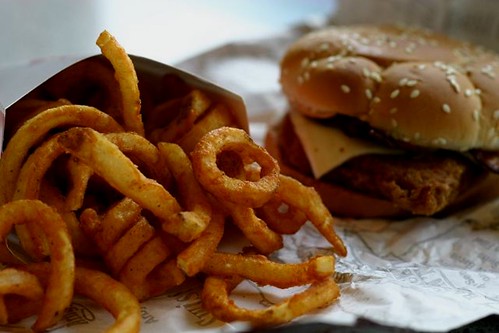
I'm feeling fat, so I think it's time to go on a diet.
Not literally. I feel I've made great progress over the past several months in my eating habits, but with my consumption of food under much greater control, it's becoming time to take the reins and get my information consumption under control.
Apparently, we now live in the information age, and each day there is an overwhelming amount to consume. It is becoming clear that I need work on developing a healthy information diet.
I have a tendency to go through cycles where I binge on the Internet, and then try to cut back drastically. It doesn't seems to be the most effective method constantly flip flopping between reading and looking at everything in sight and trying to radically reduce my inbox and RSS feed subscriptions.
I'm thinking now I need to find a better and more sustainable balance between the extremes of binging and anorexia.
Where this will lead is the big question: What is information for?
You don't have to starve yourself
First, this doesn't have to be unpleasant. I'm not prepared to come out and advocate for myself or you a low information diet. This is partly because of how much I enjoy most of what I read and watch, but also because I think a lot of the information I consume does have its place in my day and value for me.
However, there is also the fries and burgers of my daily dose that I can probably do without. I have no plans to ever give up burger and fries completely, but they work well for the point I'm illustrating. Some foods are not as good for you as others.
Finding the good ones that agree with you and denying yourself the pleasures of the others is difficult but possible. To be healthy, it is not necessary to outlaw the good tasting foods that are bad for you. It is over the top to only select fat free, low carb, low sodium, high fiber fare for each meal, but developing a healthy balance is just the ticket.
There's no right amount
There really is no clean cut answer as to how much information is the right amount of information. Again, this is very similar to any diet of food. The correct amount of information to consume depends entirely on the situation and the individuals' desired outcomes.
Michael Phelps has to consume thousands of calories per day while in training to be able to perform as he does. Models, such as Filippa Hamilton, don't have the same luxury. They are after something else entirely.
I'm sure the editors at Lifehacker have to have a very different level of information consumption to produce their massive site of useful information than that Leo Babauta needs to write his insightful posts for Mnmlist.
The input for both of these examples is, I'm sure, in direct proportion to the desired output. One is not superior to the other. They are just different and are tailored to meet the specific needs.
Balance is the key
The most important thing to find in developing a healthy information diet is the right balance.
Information consumption is no different than eating in this respect. Everything that goes in must come in and be digested. Then, it will either be used or discarded.
The correct balance is entirely dependent upon what you want to do with the information. If you're a writer, you'll want to consume everything you can about your subject so that you can write on it competently. If you're an athlete, you'll want to know about your sport so you can find your edge.
Consuming too much information without proper digestion will lead to indigestion or waste. Neither is good.
Three stages of an information diet:
1. Input: This is everything you read, see, watch, or listen to. This can be controlled by deciding what books you read, what shows you watch, which RSS feeds you subscribe to, and the music you listen to. This is also the part we only have partial control of. There are thousands of voices fighting for our attention each day. It is impossible to tune in to them all. It is also impossible to tune them all out. But it is possible to filter and highlight the things you want while blocking what you don't.
2. Reflection: This is the step where you digest everything that comes in. This can include a song getting stuck in you head, a topic that inspired another idea or project or the simple enjoyment of remembering what you watched or read. It doesn't have to be anything too deep. This stage of reflection is just the internalizing of what came in your mind.
3. Output: This is the final component of a balanced information diet. Everything that goes in will come out one way or the other. There is three possibilities in this stage. It can either come out in a productive and enriching way, go to your thighs, or it can simply be forgotten and wasted. Athletes use the food they eat to drive their performance. Couch potatoes don't, and the end results are visible. Some information can also just be forgotten and lost forever. Hopefully it was enjoyable the first time around, other it was kind of pointless.
You are what you eat
Since everything that comes in will eventually come out, it is important to remember that you are what you eat. The information that you consume becomes a part of you. This can make you better or it can make you worse, depending on what you let in and how you use it.
You can have a significant impact on your outcomes by wisely discerning and using what you consume. To do this you need to:
- Know what you are trying to achieve.
- Decide what you need to know to achieve it, and ignore the rest.
- Learn to determine how to best use the information you receive.
- Adequately reflect on the information before acting on it.
- Act on what you learn.
Have fun
A healthy information diet does not have to be austere and boring. Some of what we eat can still be just for fun: a bowl of ice cream, a scoop of cookie dough. It's the same thing with an information diet. It can be for it's own sake, but too much will make you fat.
So, I ended up doing much better than I expected in my 5k run on Thursday. I was so nervous going into it. I'm not sure why, but I think it was because I haven't engaged in any competition at all this year, and also because I was convinced that I would embarrass myself in front of my co-workers, who were all expecting fantastic times.
As it turned out, I came in first at my company, and 20th out of 150 some men. It was quite a shock to me, but in the process I learned a lot about myself and my body.
Running a race is not like other sports. It's almost impossible to size up the competition. In basketball you can make assumptions based on height, in wrestling, based on build. But good runners come in all shapes and sizes, and when you're lined up with 300 other people, there's no telling a head of time where you stand.
And once you start it doesn't matter. Once the gun goes off, it's not a competition against anyone except yourself. It's a contest between your body which is telling you to slow down and your mind which is saying, "Speed up!" Or at least it should. It seemed like half the time my mind was working against me as well.
This went on through out the whole race. I could look at people up ahead and tell myself that I was going to try to keep pace with them and try to catch up. However, the only time I was really able to gain any ground was when--instead of looking at other around me--I pushed aside my own negative thoughts and pushed aside the discomforts of running for the sake of a faster stride that I was able to gain any ground.
Throughout the race, I knew that I would have to overlook my own shortcomings if I was to succeed. I learned at the one mile marker that my weaknesses were not going to help me at all during the next two miles. Weaknesses were of no use. They would accomplish nothing. Only my strengths would be of use in trying to finish this race.
I have many weaknesses and shortcomings. These have no benefit in any circumstance. However, understanding my weaknesses is one of the first steps to take to corner and nurture my strengths. And that was how the second mile went. I found my pace and my stride. I focused on the energy moving me forward and not on the fatigue that would only slow me down. With this I was able to hold my position and even gain ground on the pack ahead.
In the third mile, my weaknesses were apparent. I had been sweating profusely throughout the second mile, and now my arms were becoming heavy. I would have thought that swinging them at my sides in the nearly frictionless air would be the easiest movement. My back also was becoming tired. I didn't even know that my back was an active participant in this run. My legs kept going even though breathing became more of a challenge.
The most difficult part of the end of this race was not knowing where the finish line was. The first two miles were clearly marked, but the final stretch had many twists and turns, cutting back and across the path. In addition to that, a 5k is 3.2 miles, and each mile became increasingly difficult so I had an impossible time judging how close I was to the finish.
Many times, tasks and challenges are like that. It gets more difficult when the end of a task or challenge is near, and it's most difficult when the end is not in site. This was no different. I wanted to keep up my pace and run steadily to the end, but with no end in sight, doubts crept in, voices saying, "You can't do it, the finish line is still far off, you'll have to slow down if you plan to finish."
But, just as I was getting ready to give in and slow down, I rounded the final corner, and out of nowhere, the finish line was in front of me. The excitement of seeing the finish line gave me an extra boost of strength that I used to transition from a run to sprint. I felt light, like I was just starting out...for the first 20 yards.
Then the previous three miles shouted: "Slow down!" But I didn't listen, and I ran as hard as I could across the finish line, passing one unsuspecting competitor as I finished.
I finished exhausted. But that's exactly how it's supposed to be. If I had anything left in me after I finished I would have been disappointed that I didn't use it on the course.
At the end of the race, I knew my weaknesses played no part in my success. Only my strengths mattered. I'm now going to be looking for other ways to apply this thinking. I can, I think, be aware of my weaknesses without letting them interfere with my strengths or goals.
The challenge will be to figure out how.
(The following is from my 2005 book of poetry, Ordinary Time, which provided the inspiration for the title of this blog. I will be republishing the poems here over the next several weeks in their original order)
Care for the Dead
Care for the Dead
To sense the life
that used to live here,
I pick up a clump
of dirt from the field
and let it crumble
between my fingers
and watch it fall
and mix back
with the earth.
Something here
has changed. I
changed and changed it.
I have desecrated
something sacred.
I ask nature
to forgive the bulldozer
of my hands, crumpling
the graves of men
I never knew,
and never cared about,
until now.
Now I come. Now the poet
in me
pretends to care.
I try. I do. But I
cannot wait for a better poet
to caress my dust
and write of his love
for the dirt
between his fingertips
and buried under his nails.

However, this is my only obstacle to becoming a writer. It doesn't take as much time as I once thought because, it seems, no one is out there trying to write the next Moby Dick. It no longer takes 1,000 pages to tell a story or to make a philosophical point about the human condition. I don't know that it ever did, but the way most readers consume information now has changed, and writing has had to change to keep up.
I'm thankful. I have a difficult enough time settling on a topic for a 1,000 word post that will take me less than an hour to complete. I don't know how I would ever be able to commit to a project whose end goal would be a five-pound tome.
This, however, does not provide an excuse for a decline in quality, even though I would be hard pressed to find someone who could argue convincingly that the quality of writing and thought in one of the new releases at Barns and Nobel or one of the books on Amazon's top 100 could even begin to rival one of the classics in its command of the English language.
It would seem that if the scope of the work I am trying to accomplish is so much narrower, and so much shorter, that I'd be able to make up some of the ground in quality. But that doesn't seem to be the case.
How does a writer of a classic think during their writing process? How do they go about developing their story or crafting their sentences? It can't be that much different than today. However, I suppose, garbage in garbage out. I'm sure the classic writers and thinkers had a much healthier diet of reading and information than I have today.
This is an external factor that I feel like I can do something about. There are a lot of messages thrown at me every day. Many marketers are fighting for my attention, and I've subscribed myself to many things that I find interesting and enjoyable, but, if this information diet is turning my stomach, polluting my mind, and hindering my writing, it may be time for some changes.
It isn't realistic, practical, or helpful to pull the plug entirely. There is still the needed flow of input needed for processing, digestion, and good quality out put, but if so much time is taken at the top of the funnel, the second two stages suffer.
What I need to develop is a more steady flow of information in, time to process and reflect, and written output at the other end. I need to turn this funnel into a cylinder with a fat middle. I actually believe that the middle, right now, is the narrowest part of the process.
Several of my writing, including this one, have begun without proper digestion in the middle. Fortunately, this one has developed into some well formed thought and reflections, and has led me to a few other ideas for posts that I will have to write: How to develop a healthy diet of information; How to develop a good balance between input, reflection, and output; and How to achieve the desired output by controlling inputs.
After a few more workouts over the past few weeks, today is the day of the 5k run. I think I'm ready for it, as ready as I could get in the short period of time between when I found out about it, when I started training, and today. I'll be writing a post about my experience and how it turns out.

So many events, images, sounds, and smells hit our minds every day, but not all of it sticks. We don't remember much of it, yet there is so much that we do.
Events that seemed insignificant at the time stay with us for our whole lives. Moment we promise ourselves to cherish grow foggy. Random episodes in our lives replay themselves in our heads, triggered by sounds, smells, or nothing at all.
There does not seem to be any set of rules that determines what you will remember and what you will forget. There is a science behind it, I suppose, but that is not what I am interested in exploring in too much depth. However, to be fair I offer the following.
Basically, external and internal stimulus cause the activation of certain chemicals within the brain which provides for a temporary remembrance, a short-term memory. As more comes in, what's there gets pushed out to make room in the short term memory, and the thoughts that are pushed out are filed and archived in long term memory.
There is so much that happens on the molecular and chemical level in the brain between the time we see or hear something and the time it gets stored in long term memory that it's a wonder we remember anything.
But we do, and that begs the question: Why do we remember what we remember?
Memory relies heavily by how the mind perceives events and what values it assigns to them. Much of what we remember depends on our levels of focus. Without focus or attention, the chances of converting experience from short to long term memory declines in proportion to the level of focus.
However, focus is not a guarantee of memory. Also, a lack of focus at the moment does not mean that a memory won't be created. Some sensations are strong enough to be pushed into long term memory, while other are not. This is why intense and extreme experiences are so memorable.
There are a number of reasons we forget and fail to remember. Sometimes memories just can't be retrieved when we try to think of them. Have you ever felt like you know the answer, maybe that you've answered the question before, but just can't bring the thought to your lips? Some things never make it past our initial experience. These events are never moved from short to long term memory.
There is also deliberate forgetting. There are some things we simply don't care to remember. They can either be unimportant and not worth the effort, or they can be a disturbing event or image that we cast from the mind. This can be deliberate or it can be an unconscious form of repression.
Memory is a mysterious thing, but it is key to understanding our world and shaping our experiences. Understanding why we remember what we do and learning how to remember what we want and forgetting what we don't will be the subject of other posts.
I've made some radical changes to my blog template, and I think I've just about configured it the way I want. That's kind of a scary thing. I mean, once I have the template figured out, the only blogging activity I'll be able to participate in is actually writing.
So far I've successfully avoided the actual work and thinking that this hobby and project will require. However, I'm ready for the change. I think it will be much more fun to write, create, and market my creation than it was just to pick out the template and fiddle with the colors and configurations.
Last night and today, I just went looking for things to tweek and change, but with such a simple and clean design it becomes harder and harder to do. Actually, I might be finished.
 It's not the job of the writer to rehash old ideas, and consolidate them into broad general statements, as much as it is to uncover new ideas through the general and collective knowledge that is already present in the world. Now finding that new knowledge, within the collective knowledge, is a skill that is not natural to the thought process. It takes a conscious uncovering in order to develop and nurture the traits before one can effectively find those new ideas even if they're in plain sight.
With the dawn of the Internet the sharing of ideas has become easier and much more accessible to a larger number of individuals. This has exponentially grown the pool of collective knowledge, and exponentially increased the way that that pool can be accessed, studied, and grown.
I see it as my task as a writer to reach into that pool or even to dive right in, swim around, see what I find, and discover the unknown creatures that reside within. I'm not sure that this is a task that I'm up for or qualified for, but it is something I have a passion for.
Who am I to write these things? That's what I'm trying to find out. And as I go forward, I understand that it will be a challenge to write in specifics about specific subject rather than flirt with the obscure, use vague generalities, or broad sweeping statements. I have a tendency to use the word 'everything' or 'everyone' which really don't have any place in good specific writing.
What this is about, then, is developing the skills and disciplines to write well about something specific. This is a simple process: pick something to write about, and while you're writing about it, don't write about anything else. I am not good at this yet because I struggle so much with the first step.
However, I'm starting to hone in my subject matter and am finding it easier to pick a subject and complete a post on it. It is more challenging for me than I imagine it is for other writers, but that doesn't bother me. The time and effort it takes to produce is ultimately not the important thing. Rather, the finished product is what matters. And this is only the beginning of what I hope will be a long and splendid journey.
